Ever sat down to tackle something important, only to find yourself staring blankly at the wall, unable to get your brain to cooperate? Before you blame Netflix or your phone or the general existential dread of Monday mornings, have a squiz at your surroundings. Chances are, the real culprit is sitting right in front of you – literally.
The Visual Cortex Wrestle
Your visual cortex – that’s the part of your brain responsible for processing what you see – is having an absolute mare when you’re surrounded by mess. Princeton University neuroscientists hooked people up to brain scanners (the fancy fMRI kind) and discovered something fascinating: when multiple objects are in your visual field at the same time, they literally compete with each other for your brain’s attention.
Imagine your visual cortex as a bouncer at a packed Brisbane nightclub. When there’s a reasonable number of people trying to get through, everything runs smooth as. But when 50 things are all shouting for attention simultaneously, even the best bouncer’s going to struggle. Your brain’s doing the same frantic juggling act, and mate, it’s exhausting.
Your Brain’s Losing Battle With Stuff
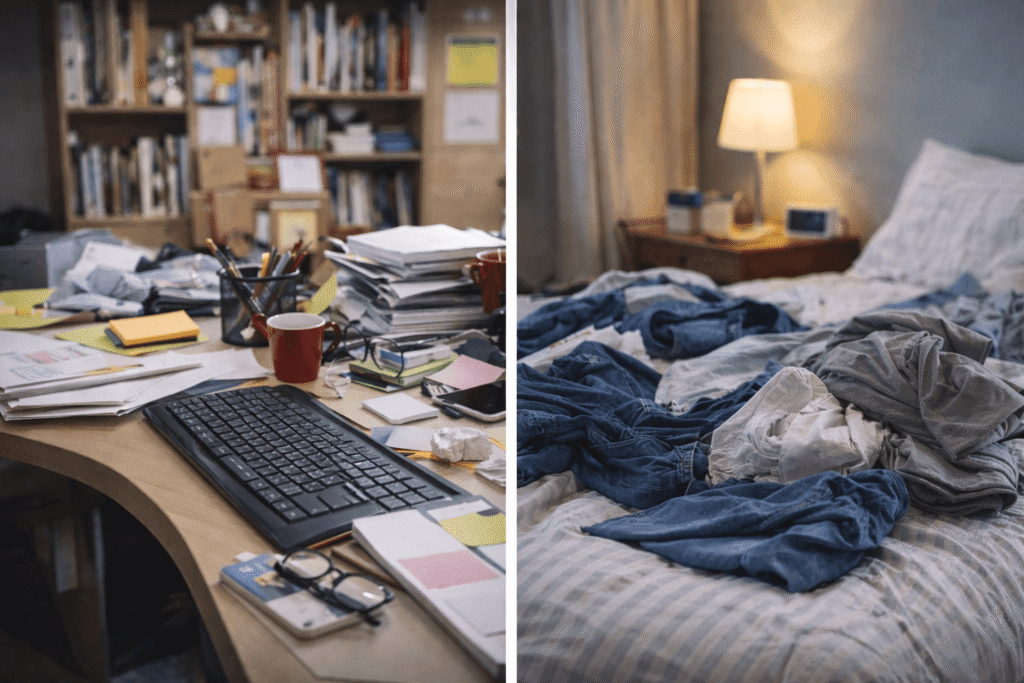
Here’s what’s happening in your cluttered space right now: your brain is constantly, unconsciously registering every single item within view. That coffee mug from this morning. The stack of papers you’ve been meaning to file since March. The random collection of pens, cables, and mystery objects that have colonized your desk. Even if you think you’re ignoring them, your brain’s taking note of every single one.
The result? Your cognitive resources get spread thinner than Vegemite on a massive piece of toast. Instead of having your full mental horsepower available for the task at hand, a chunk of it’s being diverted to process all that visual clutter. It’s like trying to run a marathon while carrying a backpack full of bricks – technically possible, but why would you do that to yourself?
The Multiple Stimuli Problem
Research shows that when your environment’s a mess, your brain has to work overtime just to filter out the irrelevant stuff and focus on what matters. Every object in your line of sight is saying “Look at me! Deal with me! Remember me!” And your poor brain’s trying desperately to ignore the lot of them while also attempting to do actual work.
Scientists describe this as your brain’s visual field being overwhelmed by competing stimuli. In plain English? Everything’s fighting for attention, and nothing wins. You end up in a state of constant low-level distraction, never quite able to sink into proper focus. It’s about as productive as trying to read a book at a music festival.
The Brisbane Home Office Struggle
With more Brisbanites working from home these days, this problem’s gotten properly real. Your “office” might be the dining table, a corner of the bedroom, or that spot in the lounge where the Wi-Fi actually works. And suddenly, all the normal household clutter that you could ignore when you weren’t trying to concentrate is now a major productivity killer.
That pile of laundry waiting to be folded? Your brain sees it. The kids’ toys scattered across the floor? Registered. The general accumulation of life’s debris that every Brisbane home collects? All of it’s competing for your attention while you’re trying to write that report or get through your emails.
Why Professional Cleaning Actually Helps
This is where regular home cleaning services in Brisbane becomes less about tidiness and more about cognitive function. When someone else tackles the deep clean, you’re not just getting a tidy space – you’re eliminating dozens of visual distractions that your brain’s been processing in the background.
Think about walking into a professionally cleaned room. There’s a noticeable difference, right? That’s not just the lack of dust or the fresh smell. It’s your brain going “Ahhhh, finally, nothing’s screaming for my attention.” Your visual cortex can actually relax instead of playing referee to a thousand competing objects.
The Focus Factor
Studies have consistently shown that people in organized, clean environments demonstrate better concentration and task performance. This isn’t about being uptight or obsessive – it’s pure neuroscience. When your visual field isn’t cluttered, your brain can dedicate more resources to actual thinking instead of constant background processing.
One fascinating study found that people working in tidy spaces were significantly better at staying on task and showed improved information processing compared to those in messy environments. The cluttered group didn’t just feel more distracted – they genuinely were more distracted, measurably so.
The Clutter Creep
Here’s the sneaky bit about visual clutter: it accumulates gradually, so you don’t notice how bad it’s gotten until you’re proper overwhelmed. It starts with one or two things out of place. Then a few more. Before you know it, your workspace looks like a bombs hit it and your ability to focus has gone walkabout.
The problem is, once it reaches critical mass, the task of tidying up becomes so overwhelming that you avoid it. And the longer you avoid it, the worse it gets. It’s a vicious cycle that’d drive anyone mad. Your brain knows it needs to be dealt with, which creates background stress, which makes it harder to deal with, which creates more stress. Round and round we go.
The Clean Slate Effect
When you clear the clutter – either yourself or by calling in professionals – your brain gets what researchers call a “clean slate.” Suddenly, your visual cortex doesn’t have to work overtime. You can actually see your desk surface again (shocking, we know). And most importantly, you can focus on one thing at a time instead of being constantly interrupted by visual noise.
Professional services like builders cleaning understand this principle. When a construction site’s been transformed into a livable space, it’s not just about removing dust and debris. It’s about creating an environment where your brain can function properly without being assaulted by visual chaos.
The Science of Seeing Clearly
Your eyes might do the seeing, but your brain does the processing. And when that processing power’s being wasted on filtering out clutter, you’ve got less available for important stuff. Like remembering why you walked into this room. Or what you were supposed to be working on. Or where you put your phone 30 seconds ago.
Research consistently shows that reducing visual clutter improves working memory, enhances creativity, and makes problem-solving easier. Your brain literally works better when it’s not constantly battling its surroundings. Makes sense when you think about it – try doing complex maths while someone’s shouting random numbers at you. That’s basically what visual clutter does to your cognitive function.
Making Space for Your Brain
The good news is that you don’t need to live in some sterile, minimalist nightmare to help your brain out. You just need to reduce the visual competition enough that your cortex can actually do its job. Regular cleaning, proper storage, and keeping surfaces clear makes a massive difference to your cognitive load.
And if you’re thinking “Yeah, but who’s got time for that?” – well, that’s exactly why professional cleaning exists. Someone comes in, sorts the visual chaos, and gives your brain a fighting chance at functioning properly. You get to focus on things that actually matter, like your work, your family, or finally beating that level you’ve been stuck on for three weeks.
The Bottom Line
Your messy space isn’t just annoying or embarrassing when someone drops by unannounced. It’s actively working against your ability to think clearly, focus properly, and get stuff done. Every item in your visual field is a tiny drain on your cognitive resources, and those drains add up fast.
So next time you’re struggling to concentrate and wondering if you’ve developed sudden-onset ADHD, have a look around. The problem might not be you – it might be the 87 objects on your desk all competing for your brain’s attention.
Clear the clutter, help your brain out, and maybe you’ll finally be able to focus long enough to remember what you were trying to focus on in the first place. Your visual cortex will thank you for it.